
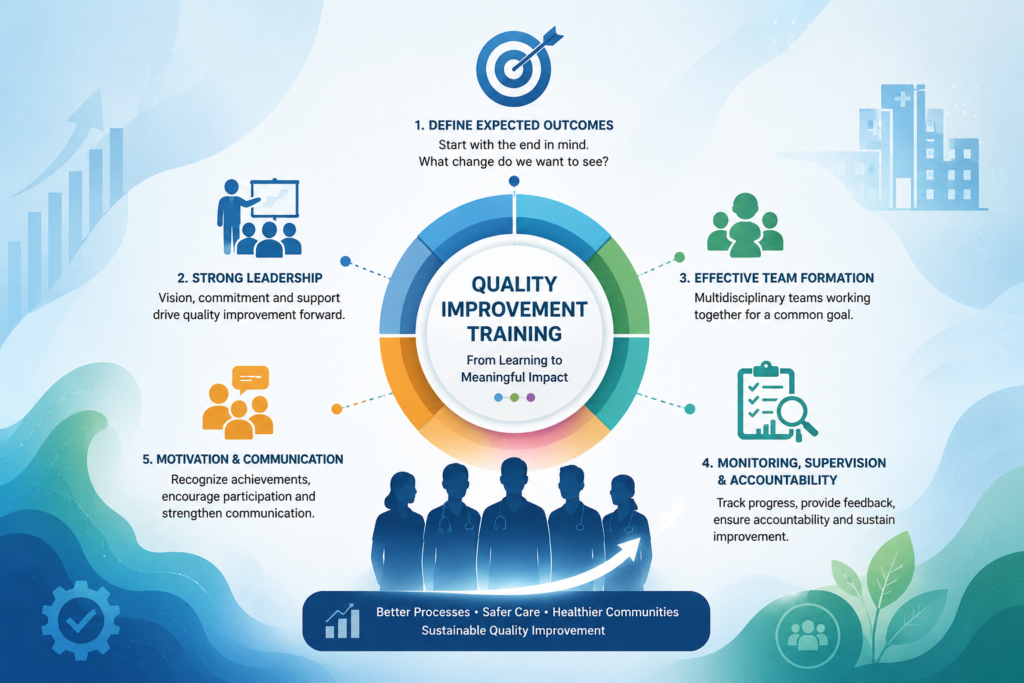
Quality Improvement Training: Start with Expected Outcomes, Not the Curriculum
Healthcare organizations invest significant resources in Quality Improvement (QI) Training every year. However, many programmes still fail to deliver sustainable improvements because they emphasize content instead of measurable outcomes.
Instead of asking, “What should we teach?” we should ask, “What changes do we want this training to achieve?”
This simple shift changes everything.
Start with the Expected Outcome
First, define the expected outcomes before designing the curriculum. Then align every learning objective, exercise, coaching activity, and evaluation method with those outcomes.
For example, ask these questions:
- What improvements do we expect in healthcare quality?
- Which patient safety indicators should improve?
- What new practices should participants implement?
- How will we measure success?
When trainers answer these questions first, they create a focused and practical training programme.
Training Alone Does Not Improve Quality
Training builds knowledge. However, knowledge alone does not improve healthcare quality.
Instead, organizations need committed leadership, empowered teams, supportive supervision, and continuous measurement.
In other words, Quality Improvement is a leadership and systems transformation process—not simply a classroom activity.
Five Pillars of Effective Quality Improvement Training
1. Define Expected Outcomes
Start with measurable improvement goals. Then design the training around those goals.
2. Build Strong Leadership
Leaders should create a shared vision, allocate resources, remove barriers, and motivate teams throughout the improvement journey.
3. Develop High-Performing Improvement Teams
Next, establish multidisciplinary teams that solve problems together, analyse data, and implement evidence-based changes.
4. Strengthen Monitoring and Accountability
Furthermore, organizations should introduce supportive supervision, regular coaching, performance reviews, and accountability mechanisms. These activities help teams sustain improvement after the training ends.
5. Promote Motivation and Communication
Finally, leaders should recognize achievements, encourage continuous learning, and maintain open communication. As a result, organizations build a culture where quality improvement becomes everyone’s responsibility.
Measure Impact—Not Attendance
Many organizations measure success by counting participants or certificates.
Instead, measure the impact.
For example, evaluate whether the programme improves:
- Quality of care
- Patient safety
- Clinical performance
- Team collaboration
- Patient experience
- Organizational performance
These indicators demonstrate whether the training has created real value.
Conclusion
Ultimately, effective Quality Improvement Training goes far beyond transferring knowledge.
Instead, it equips leaders and healthcare teams to improve systems, strengthen accountability, and achieve measurable results.
Therefore, every Quality Improvement training programme should begin with one guiding principle:
Start with the expected outcome. Build leadership. Empower teams. Measure results. Sustain improvement.
When organizations follow this approach, training becomes the beginning of lasting healthcare transformation rather than a one-time educational event.