
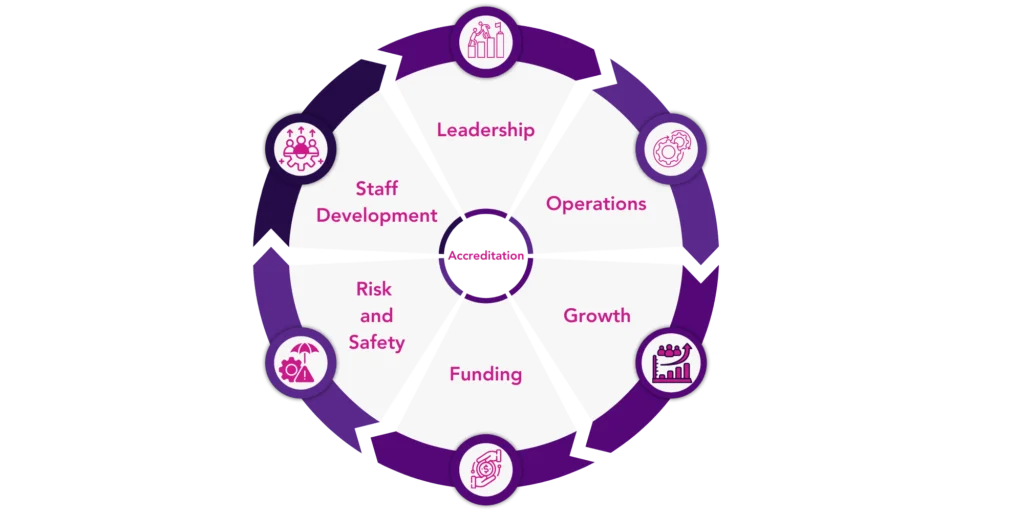
Accreditation Is Not Enough: Turning Standards into Real Patient-Centered Care
In today’s healthcare landscape, achieving accreditation is often seen as the ultimate goal for hospitals and diagnostic facilities. However, accreditation alone does not guarantee high-quality or patient-centered care for Healthcare Accreditation and Quality Care.
While accreditation frameworks provide essential standards, the real challenge lies in translating those standards into everyday practice at the facility level.
The Gap Between Accreditation and Reality
Many healthcare institutions achieve accreditation “on paper,” yet struggle with poor compliance in practice.
This gap occurs when:
- Standards are documented but not implemented
- Staff are not adequately engaged or trained
- Monitoring systems are weak or inconsistent
- Accountability mechanisms are absent
As a result, despite being accredited, facilities may fail to deliver safe, effective, and patient-centered services.
Why Accreditation Alone Fails
Accreditation is a framework—not a solution. Without the right system, it becomes a checklist exercise rather than a quality improvement tool.
Common pitfalls include:
- Lack of leadership commitment
- Poor supervision and follow-up
- Absence of real-time monitoring
- Weak culture of accountability
These factors lead to a situation where compliance deteriorates over time, ultimately compromising patient care.
Making Quality Visible at Facility Level
To make accreditation meaningful, healthcare organizations must visualize and operationalize quality at the point of care.
This requires:
- Clear standard operating procedures (SOPs)
- Routine monitoring and feedback systems
- Data-driven decision-making
- Staff ownership of quality processes
👉 Quality must be seen, measured, and continuously improved, not just documented.
The Role of Leadership
Strong leadership is the cornerstone of sustainable quality care.
Effective leaders:
- Set clear expectations for compliance
- Promote a culture of safety and accountability
- Ensure continuous training and capacity building
- Lead by example in adhering to standards
Without leadership, accreditation remains a static certificate rather than a dynamic process.
Monitoring, Supervision, and Accountability
To sustain quality, healthcare systems need:
✔ Monitoring & Supervision
- Regular audits
- Performance indicators
- Real-time data tracking
- Supportive supervision
- On-site guidance
- Continuous feedback
✔ Accountability
- Defined roles and responsibilities
- Performance-based evaluation
- Corrective actions (CAPA)
These elements ensure that standards maintained consistently over time.
The Impact on Patient-Centered Care
Challenge :
- Patient safety is compromised
- Service quality declines
- Trust in healthcare systems decreases for Accreditation
when leadership and accountability are strong:
- Patient experience improves
- Clinical outcomes improve
- Healthcare systems become more resilient
Conclusion: From Certification to Transformation
Accreditation is an important milestone
To truly improve healthcare quality, institutions must move beyond certification and focus on:
- Leadership-driven implementation through Healthcare Accreditation and Quality Care
- Continuous monitoring
- Strong accountability frameworks
👉 Only then can accreditation evolve from a paper-based achievement into a living system of patient-centered care.