
The Case for Systemic Reform: Beyond Top-Down Fixes – Why Bangladesh Needs the Health Reform Commission Report Now
Introduction
As someone who has dedicated the last 30 years to Bangladesh’s health sector, working closely with policymakers, frontline workers, and communities, I’ve witnessed firsthand the highs and lows of our healthcare system. From the early days of expanding vaccination programs in the 1990s to more recent efforts in piloting community clinics, the progress has been undeniable—maternal mortality has dropped from over 500 per 100,000 live births in the early 2000s to around 170 today, and life expectancy has risen to 73 years. Yet, these gains often feel fragile, built on shaky foundations. Time and again, I’ve seen well-intentioned top-down initiatives—government-led pilots, donor-funded projects, and emergency responses—launch with fanfare only to falter due to systemic flaws. For instance, during the 2010s, I observed multiple health financing schemes aimed at reducing out-of-pocket expenses that collapsed under bureaucratic red tape and lack of local buy-in, leaving rural families still burdened with crippling costs.
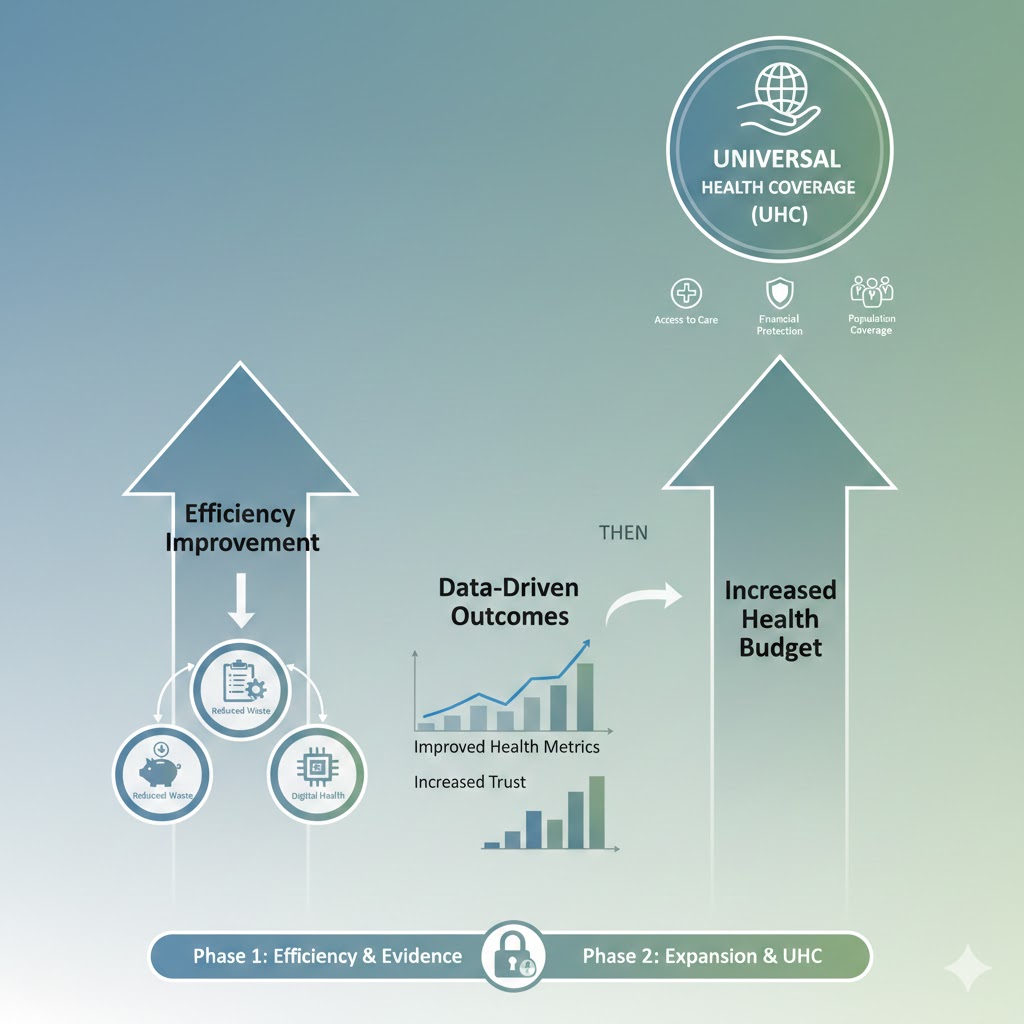
The recent political shifts, including the student-led people’s movement of July-August 2024 that led to the interim government, have opened a window for real change. The Health Sector Reform Commission, formed under this government and led by Professor A K Azad Khan, submitted its landmark report in May 2025. This report isn’t just another document; it’s a blueprint for systemic overhaul, emphasizing seven key pillars: health services and infrastructure, leadership and governance, workforce management, education and training, essential medicines and technology, financing, and information systems. Drawing from extensive stakeholder consultations, including inputs from groups like the UHC Forum where I contributed through dialogues, it calls for embedding health as a constitutional right and creating independent institutions to ensure sustainability. Without adopting these reforms, Bangladesh risks repeating the cycle of short-lived fixes, stalling our path to Universal Health Coverage (UHC) by 2030 and SDG 3 (Good Health and Well-Being). In this blog, I’ll share my observations on why top-down approaches have failed, backed by evidence, and argue for urgent action on the Commission’s recommendations.
Evidence of Past Failures: Lessons from 30 Years on the Ground
Over my three decades in the field, I’ve seen countless top-down initiatives promise transformation but deliver only temporary relief. Take the Health Care Financing Strategy (2012–2032), which introduced social health protection schemes for below-poverty-line households. On paper, it aimed to cut financial hardships, but in practice, low awareness—only 19.1% of beneficiaries knew about free diagnostics—and rigid rules limited utilization to 16.1%. I recall consulting on similar pilots in the early 2000s, where funds poured in for urban clinics, yet rural areas remained underserved due to fragmented governance. By 2022, only 61% of the population accessed basic services, far below WHO benchmarks, with stunting affecting 31% of under-fives.
Global evidence mirrors this. In sub-Saharan Africa, supply restocking programs failed due to ignored local demands, leading to shortages. Similarly, in Bangladesh, the National Health Compact (2025) pledged to strengthen primary care, but without institutional reforms, progress stalled. A systematic review of health reforms shows 50% of quality initiatives fail from hasty planning and stakeholder resistance. My own experience echoes this: During the COVID-19 response, top-down vaccine drives succeeded initially but exposed workforce gaps—rural doctors at just 0.8 per 1,000 people—leading to uneven coverage.
To illustrate the financial strain, consider out-of-pocket (OOP) payments, which account for 74% of health expenditures, pushing 5.7 million into poverty yearly. Here’s a chart showing the trend:
This data underscores how without systemic fixes, like improved risk-pooling, gains erode. Social media echoes these frustrations.
Challenges: Systemic Barriers Hindering Progress
The core challenges stem from deep-rooted systemic issues that top-down fixes overlook. First, fragmented financing: Despite commitments, OOP burdens persist, with medicine costs rising and corruption exacerbating inequities. In my 30 years, I’ve seen pilots like community clinics expand in the 2000s, only to face medicine shortages and untrained staff, resulting in low utilization. Geographic disparities compound this—rural areas lag with poor infrastructure, long travel distances, and corruption.
Second, weak governance: Siloed structures and lack of oversight lead to policy-implementation gaps. For example, during anti-poverty health strategies I advised on, long lags between funding and outcomes undermined efforts. Persons with disabilities face acute barriers, with 52% citing costs as the top issue. Urban pilots like Aalo Clinic show promise but struggle with high patient loads and limited options, highlighting integration needs.
Third, workforce shortages: With doctors concentrated in cities, primary health care (PHC) suffers. I’ve observed fresh graduates avoiding rural posts due to poor incentives, echoing global “measure fixation” where targets prioritize metrics over quality. Climate impacts add layers, with floods straining already weak systems.
Without addressing these, UHC remains elusive, as evidenced by persistent stunting and wasting rates.
Solutions: Implementing the Health Reform Commission Report
The Commission’s report offers actionable solutions rooted in systemic reform. Key recommendations include:
- Constitutional Amendment: Recognize primary healthcare as a fundamental right, ensuring free access and aligning with SDG 3.
- Legal Reforms: Update all health laws, including new acts like the Bangladesh Health Commission Act and Public Health Act.
- Independent Institutions: Establish the Bangladesh Health Commission (BHC) for oversight and a separate Bangladesh Health Service cadre to professionalize the workforce.
- Financing and Digital Tools: Reform financing to reduce OOP, introduce flexible demand-side funding, and leverage digital systems for monitoring.
- Workforce and Equity Focus: Invest in training, incentives for rural postings, and inclusive measures for vulnerable groups.
From my experience, these align with successful models elsewhere, like Thailand’s UHC, which succeeded through governance overhauls. Implementing them could bridge gaps in PHC, prevention, affordability, and accessibility, fostering a resilient system.
Call to Action: Time to Act for a Healthier Bangladesh
The evidence is clear: Without systemic reform, Bangladesh’s health gains will remain vulnerable. As someone who’s seen failed initiatives firsthand, I urge the new government, including the BNP, to prioritize the Health Reform Commission Report. Policymakers, join the dialogue—implement the BHC and constitutional changes now. Stakeholders, share your stories on social media using #HealthReformBD. Contact your representatives and support organizations like the UHC Forum. Together, we can achieve UHC by 2030, delivering equitable, sustainable health for all. Let’s not wait for another crisis; the time for reform is now.