
Introduction
Achieving UHC in Bangladesh remains a major challenge despite strong economic growth. Currently, the country’s Universal Health Coverage (UHC) Service Coverage Index stands at only 54—far below the global average of 71. At the same time, high out-of-pocket (OOP) expenditure continues to push millions of families into financial hardship.
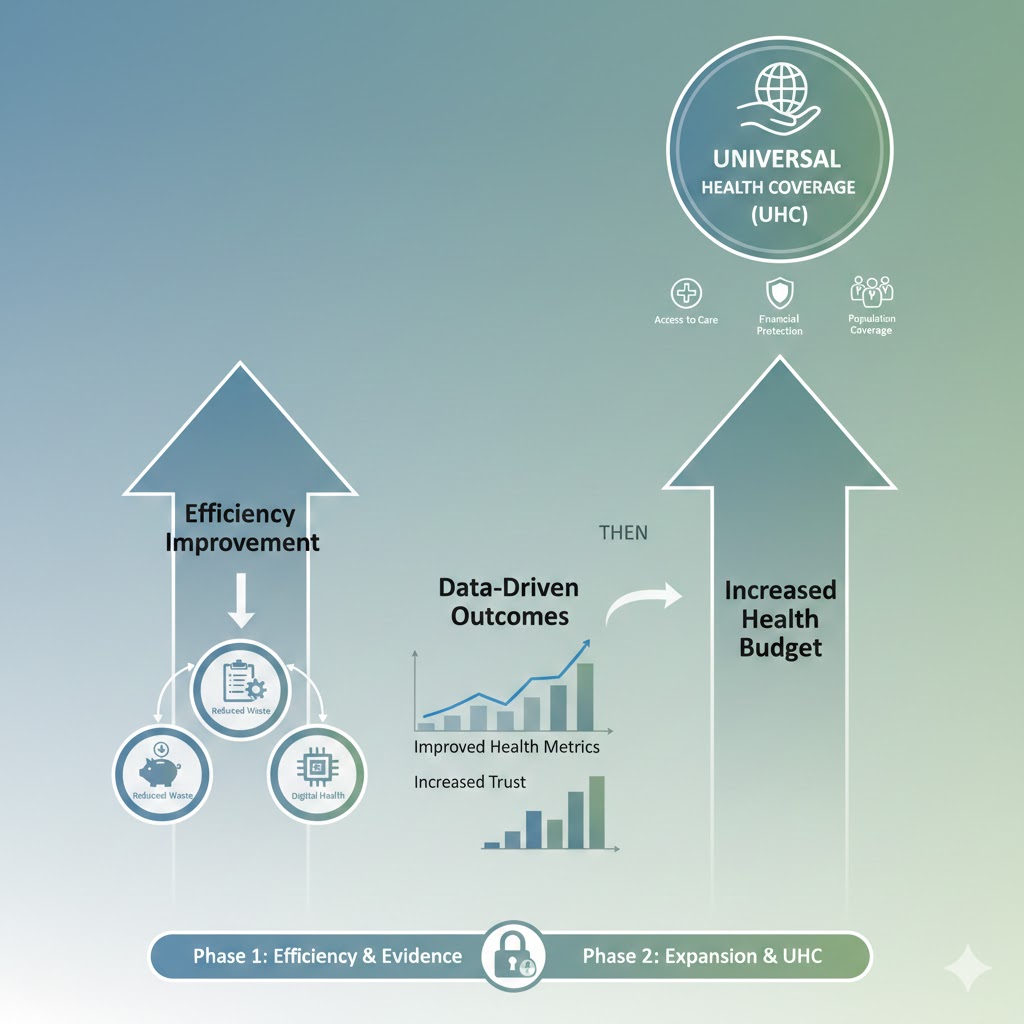
However, the real solution is not simply increasing the health budget. Instead, Bangladesh must focus on improving efficiency and effectiveness within the existing health system.
Current Challenges of UHC in Bangladesh
Despite progress in life expectancy, immunization, and maternal health, several structural problems persist:
- UHC Service Coverage Index: 54/100
- Out-of-Pocket (OOP) Expenditure: Over 70%
- Health Budget: Limited compared to need
- Shortage of skilled health workforce
- Weak governance and accountability
- Heavy reliance on the private sector
👉 These indicators clearly show that UHC in Bangladesh cannot be achieved without systemic reform
Why Efficiency Matters More Than Budget Increase
A common assumption is that increasing health spending will solve the problem. However, global evidence suggests otherwise.
Many countries fail to achieve UHC despite higher spending due to inefficiency in resource use. According to the World Health Organization, nearly 78.5% of countries do not fully utilize their health resources.
👉 Research shows that improving efficiency alone can increase UHC coverage by 4–8%, and in Bangladesh, this could reach up to 8.7% without increasing the budget.
Key Inefficiencies in Bangladesh’s Health System
Several operational gaps are reducing system performance:
1. High Vacancy and Workforce Misallocation
Many positions remain vacant, while skilled professionals are often deployed in the wrong locations.
2. Weak Accountability
Absenteeism and lack of monitoring reduce service quality and efficiency.
3. Low Hospital Efficiency
Secondary hospitals operate at only 73–80% efficiency, below the average for similar countries.
How Bangladesh Can Improve Health System Efficiency
To strengthen UHC in Bangladesh, practical and evidence-based reforms are needed:
1. Digital Monitoring and Accountability
Introducing digital tracking systems can monitor staff attendance, performance, and resource use. In India, such systems improved accountability by up to 30%.
2. Smart Human Resource Planning
Proper deployment of healthcare workers can reduce vacancies and improve service delivery.
3. Strengthening Primary Health Care (PHC)
Modernizing community clinics, improving supply chains, and training frontline workers can significantly improve access and outcomes.
4. Governance and Anti-Corruption Measures
Improving transparency, reducing corruption, and introducing performance-based incentives can increase system efficiency.
5. Data-Driven Decision Making
Using AI and predictive analytics can help forecast disease trends and optimize resource allocation.
Global Lessons: What Works
Countries like Thailand, Rwanda, and Costa Rica have successfully improved UHC by focusing on efficiency before increasing budget.
👉 Example:
Thailand reduced OOP expenditure to around 15% through system reform and strong governance.
Why Increasing Budget Alone Is Not Enough
Looking at global examples:
- USA: Spends ~18% of GDP on health but still struggles with UHC
- India: Increased spending, yet OOP remains high (~47%)
👉 These cases prove that more spending without efficiency leads to waste, not better outcomes
The Smart Path Forward for Bangladesh
Instead of focusing only on budget expansion, Bangladesh should:
- Optimize existing resources
- Strengthen governance
- Improve accountability
- Prioritize Primary Health Care
👉 With these reforms, Bangladesh can:
- Reduce OOP expenditure significantly
- Increase UHC coverage
- Achieve sustainable health outcomes
Conclusion
The future of UHC in Bangladesh depends on smart reform, not just higher spending. By eliminating inefficiencies and strengthening system performance, the country can achieve meaningful progress without immediate budget expansion.
🔥 Key Insight (Featured Snippet Target)
Bangladesh can improve UHC coverage by up to 8.7% without increasing its health budget—simply by improving system efficiency.