
Digital NCD Registries in Bangladesh: From Missed Visits to Follow-Up
By Dr. Md. Aminul Hasan | Quality Care Concern
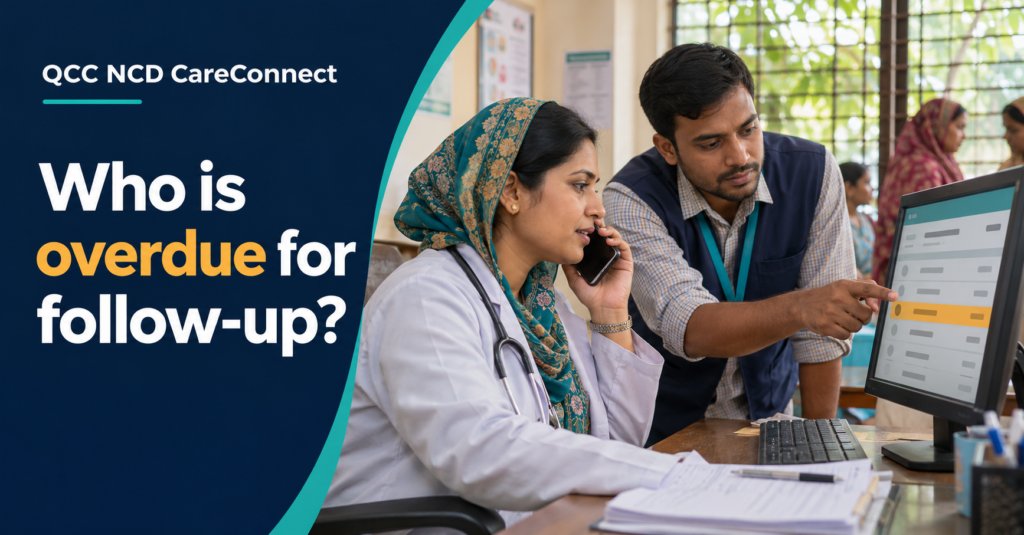
A patient with hypertension misses a scheduled appointment at an Upazila Health Complex. Her blood pressure readings, prescription and next visit date are in the digital register. Can the care team see that she is overdue, know who should contact her, and record whether she returned?
That missed visit is a practical test of a digital NCD registry in Bangladesh. For hypertension and type 2 diabetes, the value of a patient record grows when the care team can use it between visits. A registry can show who needs attention. The workflow around it determines whether anyone acts.
Why continuity of NCD care matters in Bangladesh
The World Health Organization’s Bangladesh STEPS report estimated that noncommunicable diseases accounted for 73.2% of all deaths in Bangladesh in 2017. That historical estimate puts the scale of the problem in perspective. At facility level, the challenge is to sustain care across repeated visits, including monitoring, medicine refills and referrals. A patient can be enrolled and counted in a monthly report while still missing the next step in care. who.int
This distinction matters for NCD Corners and the facilities they work with. An enrollment count tells managers how many people entered the programme. An overdue list tells a care team whom it may need to contact this week. A record of outreach and return visits then shows whether the team reconnected those patients with care. Each measure answers a different question.
What the systematic review tells us about registry implementation
Lazem and Sheikhtaheri’s systematic review of 45 studies across different types of health registries found recurring barriers in data quality, funding, management and stakeholder engagement. The authors also found that limited interoperability can force teams to collect the same information more than once, adding cost. Training, sound data collection processes and technical support were among the factors that helped implementation. ouci.dntb.gov.ua
My reading of the review is that these barriers reinforce one another. If staff have to enter a return date in two systems, the dates may diverge. If staff cannot tell which date is current, they may stop trusting the overdue list. If no one is assigned to review the list or record the outcome of outreach, even a technically accurate alert can sit unactioned. In practice, data quality is part of the care workflow. Who enters the date, who checks it, and who acts on it all affect whether the information is useful.
What Bangladesh’s hypertension programmes show
Bangladesh’s experience with the Simple app offers a concrete example. The Bangladesh Hypertension Control Initiative has used it to record blood pressure, prescriptions and follow-up dates, generate overdue lists and support patient outreach. In a randomized study within the programme, 26.5% of overdue patients who received a text reminder attended within 15 days, compared with 20.7% who received no reminder. The study enrolled patients with valid mobile numbers, so it leaves an important operational question for clinics to investigate. How will they reach patients whose numbers are missing or out of date? pmc.ncbi.nlm.nih.gov
A separate quasi-experimental study of the WHO HEARTS package in rural Bangladesh found fewer missed clinic visits in the intervention group than in usual care (8.8% versus 39.3%). The result reflects the broader HEARTS package. Together, the two studies show the value of asking different questions. The first tested a specific outreach action. The second evaluated a coordinated approach to hypertension care. Neither study measured the effect of a digital registry alone on long-term outcomes for people with type 2 diabetes. pmc.ncbi.nlm.nih.gov
What QCC NCD CareConnect should verify in the field
For QCC NCD CareConnect, the first question is whether existing tools support the entire follow-up process under routine working conditions. Simple already provides overdue-list functionality in the Bangladesh hypertension programme. The practical question is how reliably a specific team can use that functionality during a busy clinic week, and where the process breaks down. pmc.ncbi.nlm.nih.gov
| What to check | What it tells the care team |
|---|---|
| Can staff retrieve the same patient record at each visit and see a valid next-visit date? | Whether the overdue list has a dependable starting point. |
| Can staff identify overdue patients and see who is responsible for contacting them? | Whether the list fits the team’s daily work. |
| Can staff record whether a patient was reached, returned, transferred or remained overdue? | Whether outreach led to a documented next step. |
| Can the team recognize patients who cannot be reached by phone or who received care elsewhere? | Where a digital reminder or a single facility’s record gives an incomplete picture. |
A small quality improvement pilot could track the proportion of overdue patients who return within 30 days of being flagged, alongside staff time and the proportion of patients with a valid contact number. If the overdue list already works, the pilot can focus on the next gap the team verifies, such as assigning outreach or recording its outcome.
The test is what happens after the alert. Can the team say who was contacted, who returned, and who still needs help getting back into care?
Sources
- Lazem and Sheikhtaheri’s systematic review of registry implementation
- WHO Bangladesh STEPS report
- Bangladesh HEARTS programme experience and lessons
- Randomized study of text reminders for hypertension follow-up in Bangladesh
- Evaluation of the WHO HEARTS hypertension control package in rural Bangladesh